


Product Information
What is Txtai?
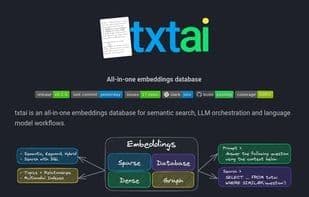
An embedded database is a combination of vector indexing (sparse and dense), graph networks, and relational databases. This enables vector search to utilize SQL, topic modeling, retrieval-augmented generation, and more.
Embedded databases can exist independently and/or serve as a powerful knowledge source for large language model (LLM) prompts. Key features of txtai’s capabilities include:
🔎 Vector search using SQL, object storage, topic modeling, graph analysis, and multimodal indexing
📄 Creating embeddings for text, documents, audio, images, and videos
💡 Pipelines powered by language models for running LLM prompts, queries, labeling, transcription, translation, summarization, and more
??? Workflows that integrate pipelines and consolidate business logic. txtai workflows can range from simple microservices to multi-model processes. Built using Python or YAML. API bindings available for JavaScript, Java, Rust, and Go.
??? Run locally or at scale using container orchestration.
txtai is built with Python 3.8+, Hugging Face Transformers, Sentence Transformers, and FastAPI. It is open-source under the Apache 2.0 license.
How to use Txtai?
txtai is an all-in-one open-source embedded database combining vector indexing, graph networks, and relational databases, designed to provide a robust knowledge source for semantic search, large language model (LLM) prompts, and support for various AI tasks.
Core Functions of Txtai
Vector database, semantic search
Usage Scenarios of Txtai
- Perform SQL-based vector searches
- Serve as a knowledge source for large language model (LLM) prompts
- Conduct topic modeling
- Implement retrieval-augmented generation
- Handle tasks like Q&A, labeling, transcription, translation, and summarization
- Create embeddings for text, documents, audio, images, and videos
Common Questions about Txtai
What does txtai do?
How do I use txtai?
What are the core features of txtai?
What are the use cases for txtai?