



Product Information
What is Chapel?
Chapel is a programming language specifically designed for efficient large-scale parallel computing.
Why Chapel? Because it simplifies parallel programming with elegant support in the following areas:
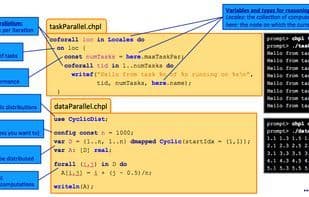
- Distributed arrays that leverage the memory and cores of thousands of nodes
- A global namespace allowing direct access to local or remote variables
- Data parallelism for easy utilization of cores on laptops, clusters, or supercomputers
- Task parallelism to create concurrency within or across nodes
- GPU programming in a vendor-neutral manner using the same features as above
**Chapel Features**
- **Productive**: Code tends to be as readable and writable as Python
- **Scalable**: Runs on laptops, clusters, clouds, and HPC systems
- **Fast**: Performance competes with or surpasses C/C++ & MPI & OpenMP
- **Portable**: Can be compiled and run in almost any *nix environment
- **Open Source**: Hosted on GitHub and licensed for free use
How to use Chapel?
Chapel is a programming language designed for efficient large-scale parallel computing. It simplifies parallel programming by elegantly supporting distributed arrays, global namespaces, data parallelism, task parallelism, and GPU programming.
Core Functions of Chapel
Parallel Computing
Usage Scenarios of Chapel
- Distributed array computation utilizing the memory and cores of thousands of nodes.
- Perform data parallel computing on laptops, clusters, or supercomputers.
- Create concurrent tasks within a node or across systems.
- Perform vendor-neutral GPU programming.
- Implement parallel file I/O operations.
- Simulate one-dimensional heat diffusion.
Common Questions about Chapel
What does Chapel do?
How do I use Chapel?
What are the core features of Chapel?
What are the application scenarios of Chapel?