



Product Information
What is Leaf node monitoring?
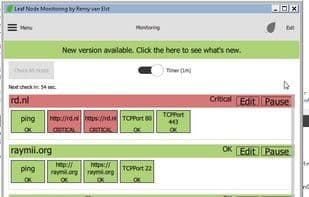
Open-source (GPLv3) network monitoring for Windows, Linux, and Android. Written in C++ and Qt 5. Perfect for running on your desktop and keeping an eye on servers. Simple setup, automatically detects running services, performs concurrent checks, open port scans, and alerts. Hosts that fail checks automatically rise to the top, while those functioning well stay green and good. Leaf Node Monitoring is a straightforward tool designed to alert you when a server or website becomes unavailable. No complex configurations, no editing config files, no managing Kubernetes clusters—just run a quality piece of software locally. In my over 10 years as a system administrator, I've set up and managed nearly every monitoring suite you can think of, each with its place. Leaf Node Monitoring might not suit large teams needing intricate alert rules or conditional checks, but that's not its aim. The only tool almost as simple is Hugo Nabais' cStatus, but it's Windows-only and not open-source. It inspired Leaf Node, and I still use it on my Windows machine.
How to use Leaf node monitoring?
Leaf Node Monitoring is an open-source network monitoring tool for Windows, Linux, and Android, primarily designed to alert users when servers or websites are unavailable. It offers simple setup and local operation, making it easy to monitor hosts.
Core Functions of Leaf node monitoring
Lightweight
Website Monitoring
Uptime Monitoring
Server Monitoring
Application monitoring
Usage Scenarios of Leaf node monitoring
- Monitor servers on desktop devices
- Monitor website availability
- Receive alerts when servers are unavailable
- Receive alerts when websites are unavailable
- Automatically detect and check running services
Common Questions about Leaf node monitoring
What does Leaf Node Monitoring do?
How do I use Leaf Node Monitoring?
What are the core features of Leaf Node Monitoring?
What are the application scenarios of Leaf Node Monitoring?