


Product Information
What is Object constraint language environment?
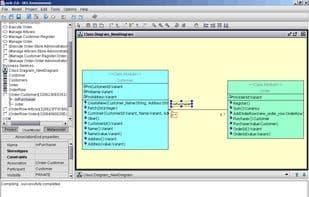
OCLE is a UML CASE tool that provides comprehensive OCL support at both the UML meta-model and model levels.
Initially, our primary goal was to design and implement a tool useful for UML practitioners. In this regard, the first objective was to achieve the necessary support for checking the well-formedness of UML models according to the Well-Formedness Rules (WFR) specified in UML 1.5.
To accomplish this, we corrected the attached operations and well-formedness rules. The sample directory included in this release contains all the AOs and WFRs we used in various tests. You can use these specifications or your own to check your models. OCLE offers robust support for compiling and debugging OCL specifications.
You can work with UML models saved in XMI 1.0 or 1.1, regardless of the tools and parsers used to generate and transfer the models.
Beyond the OCL support provided at the meta-model level, OCLE also assists users in performing static and dynamic checks at the user model level. Dynamic support is facilitated through generated Java source code. In this context, it is worth highlighting the quality of the code generated for the model schema and OCL specifications, as well as the robustness of the glue code that integrates all generated components.
Semantic checking of XML documents described by DTDs is one of the direct applications of UML model checking. To enable this, OCLE supports reverse engineering of DTD files.
Last but not least, the graphical interface was designed and implemented to facilitate the natural and intuitive use of OCLE. In addition to the new features introduced in version 2.0, the release package includes a highly useful user manual and several detailed examples.
How to use Object constraint language environment?
OCLE is a UML CASE tool with full OCL support at meta-model and model levels, aiding UML practitioners in checking model规范性 and supporting OCL compilation/debugging.
Core Functions of Object constraint language environment
Java-based, Object-oriented Language, Code Generation, Create UML Entities
Java-based
Object-oriented language
Code Generation
Create UML Entities
Usage Scenarios of Object constraint language environment
- Check the compliance of UML models
- Compile and debug OCL specifications
- Perform static and dynamic checks on user models
- Conduct semantic checks on XML documents described by DTD
- Perform reverse engineering on DTD files
Common Questions about Object constraint language environment
What does OCLE do?
How do I use OCLE?
What are the core features of OCLE?
What are the application scenarios of OCLE?