

Overseas Marketing Guide Articles
Home-Overseas Information


Australia's Under-16 Social Media Ban Effectiveness Report

Overview of the eSafety Commissioner's Report
Australia’s eSafety Commissioner has released a report evaluating the effectiveness of the country's under-16 social media ban. The findings indicate that the majority of underage teenagers continue to access social applications, even as major platforms gradually enhance their enforcement measures.
This report serves as a follow-up to the Commission's April update, which assessed the initial three months of the ban and its effects on teenagers.
Survey Methodology and Key Findings
The new report draws from a survey involving 4,121 children aged 10 to 16 in Australia, along with one of their parents. It provides a broader analysis of responses compared to the earlier update.
According to the data, the ban has resulted in fewer underage users maintaining accounts on major social apps. However, overall usage has not declined significantly, as many teens access these platforms without logging in or by circumventing the restrictions.
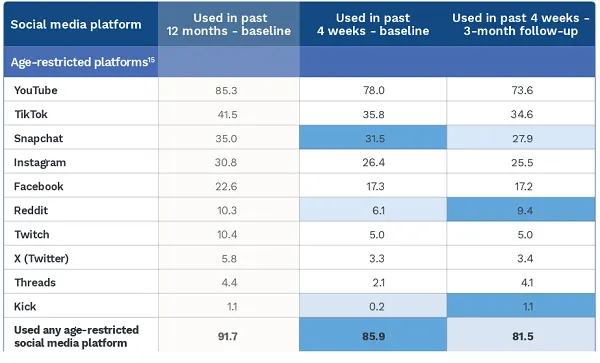
As shown in the table, at the time the ban was implemented, 85.9% of Australian teens reported regular use of at least one age-restricted platform. The latest data reveals a modest decrease, with 81.5% of underage users still accessing restricted apps.
The report states: “We note that several social media platforms can be accessed without logging into an account. Children may also use social media through accounts belonging to others, such as parents, siblings or friends. Given this, and the discrepancy between the proportion of children who reported holding their own social media account and the proportion who reported using social media platforms, the data reported here likely reflects usage both with and without children being logged into their own account.”
While accessing apps without logging in limits the full experience, the report suggests this may reduce harmful exposure for teens. Nonetheless, teenagers are still finding methods to engage with social media despite the restrictions.
Platform-Specific Impacts and User Shifts
The survey data highlights varying effects across platforms. Snapchat experienced a notable drop in teen usage, falling from 31.5% at the ban's launch to 27.9% after three months.
Additionally, the report notes an increase in underage teens using Reddit and Kick, potentially due to displacement from larger apps.
The primary factor allowing children to retain age-restricted accounts is attributed to ineffective age assurance by platforms. The report explains: “Across age-restricted platforms, the main reason children gave for why they still held an age-restricted account was that the platform hadn’t yet asked them to confirm their age (50.2%).” Other reasons include platforms incorrectly estimating age (18.2%) and children listing their age as 16 or above (37.1%). Methods like using VPNs or receiving parental assistance were less frequent.
Contrary to some predictions, the widespread use of VPNs to bypass restrictions has not materialized, possibly because most teens retain some level of access without such tools.
Broader Effects on Teen Behavior
The report indicates that young teens are allocating more time to messaging apps and online video games following the ban.
It further states: “At three months, most children reported that there was little to no change in their engagement with offline activities, behaviours associated with problematic online use, and their wellbeing.”
In essence, the majority of Australian teens continue to access restricted social media apps in various ways. The ban has prompted greater use of alternative digital connection tools, aligning with predictions that online social behaviors would persist.
For more details, refer to the full report from the eSafety Commissioner at https://www.esafety.gov.au/research/social-media-age-restrictions-evaluation/early-days-early-insights-three-months-report. Like.tg continues to monitor developments in social media regulations worldwide.
Contact Us