


Product Information
What is Oku web browser?
A web browser with a strong focus on local-first data storage.
Make browsing fun again.
Create and publish websites
Share files directly with friends
Store personal data on devices you control
Sync files across devices
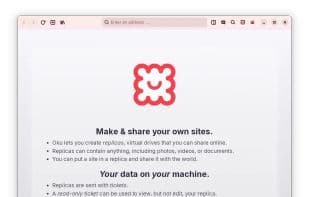
Build and share your own websites.
OKU lets you create replicas—virtual drives that can be shared online.
Replicas can hold anything, including photos, videos, or documents.
You can place a website inside a replica and share it with the world.
Your data stays on your computer.
Keep your information on your own sites, not on servers controlled by others.
Replicas come with tickets.
Read-only tickets allow viewing but not editing your replica.
Read-and-write tickets enable both viewing and editing your replica.
Websites can safeguard your data by requiring read-and-write tickets.
Let your garden grow wild.
Carve out your own space on the internet, independent of social media platforms.
Replicas can be viewed by their ID.
Each time you visit a new replica, your browser saves its ID.
When you update a replica, those with the ID see the latest version.
Not Google Chrome in disguise.
OKU is powered by Webkit—a true alternative to Google Chrome, not a derivative.
How to use Oku web browser?
Oku is a web browser emphasizing local-first data storage, aiming to give users back control of their data and offering the ability to create, publish, and share websites and files.
Core Functions of Oku web browser
Privacy-focused, No Registration, No Tracking, Dark Mode, No Ads, Local Storage
Privacy-first
No Registration Required
No Tracking
Dark Mode
Ad-Free
Local Storage
Usage Scenarios of Oku web browser
- Create and publish personal websites
- Share files directly with friends
- Store personal data on user-controlled devices
- Sync files across different devices
- Build independent online spaces away from social media platforms
- Create personal knowledge bases to record browsing content
Common Questions about Oku web browser
What does Oku do?
How do I use Oku?
What are the core features of Oku?
What are the application scenarios for Oku?