


Product Information
What is Roboconf?
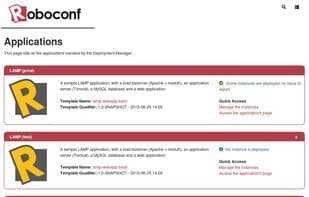
Roboconf accepts input in the form of application descriptions.
An application description is a zip archive that includes a list of software components and their relationships (what is deployed on what and what depends on what). Each component comes with recipes to handle its lifecycle. In addition to the classic phases (deploy, start, stop, and undeploy), there is a special phase called "update," which is invoked whenever a dependency changes.
This is key to enabling hot reconfiguration and resilience for applications. Other aspects of the application can also be provided, such as probes, probe configurations, complex script commands, and automated reactions. Roboconf offers several extension points.
One is for plugging in deployment environments (e.g., for cloud infrastructure providers). Another supports new recipe types (scripts, Puppet modules, etc.). There is also one for defining new probes.
It comes with a variety of tools, including a web console, an Eclipse plugin, a Maven plugin for automated builds, and a documentation generator. Roboconf is mostly developed in Java/OSGi, but some parts rely on JavaScript (AngularJS, etc.).
How to use Roboconf?
Roboconf is a lightweight platform for deploying and scaling distributed apps in clouds or IoT, enabling hot reconfiguration and elasticity.
Core Functions of Roboconf
Docker Support
Cloud Monitoring
Platform as a Service
Usage Scenarios of Roboconf
- Deploy and scale applications in cloud environments.
- Deploy distributed applications in connected objects.
- Manage application lifecycle, including deployment, start, stop, and updates.
- Implement hot reconfiguration and elasticity for applications.
Common Questions about Roboconf
What does Roboconf do?
How do I use Roboconf?
What are the core features of Roboconf?
What are the application scenarios for Roboconf?