



Product Information
What is Wzd?
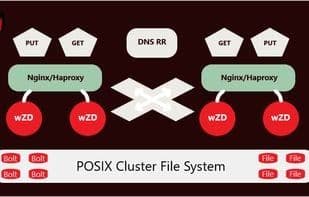
wZD is a server written in Go that utilizes a modified version of the BoltDB database as its backend. It stores and distributes any number of small or large files, NoSQL key/value pairs, in a compact form within micro Bolt databases (archives). The distribution of files and values in BoltDB depends on the number of directories or subdirectories and the general structure of the directory hierarchy. wZD permanently solves the issue of handling massive numbers of files on any POSIX-compatible file system, including clustered file systems. On the surface, it operates similarly to a conventional WebDAV server.
...Billions of files will no longer be a problem.
Features:
- Multithreaded
- Multi-server fault tolerance and load balancing
- Full file and value search capabilities
- Supports HTTPS and IP authorization
- Supported HTTP methods: GET, HEAD, OPTIONS, PUT, POST, and DELETE
- Manages read/write behavior via client headers
- Supports customizable virtual hosts
- Linearly scales read/write operations with clustered file systems
- Efficient data read/write methods
- Supports CRC data integrity during writes or reads
- Easy data sharding across thousands or millions of Bolt archives based on directory structure
- Hybrid mode support, allowing large files to be stored separately from Bolt archives
- Includes the multithreaded wZA archiver for migrating files without service interruption
The wZD server is designed for hybrid use. It not only writes regular files but can also generate HTML or JSON documents on the fly, or simply function as a NoSQL sharded database composed of numerous small BoltDB databases, with all sharding managed through the structure of directories and subdirectories.
How to use Wzd?
wZD is a server written in Go that uses a modified BoltDB as its backend to compactly store and distribute large volumes of files and NoSQL key/value pairs. It addresses the challenges of storing massive files on POSIX-compliant file systems and can function as a WebDAV server.
Core Functions of Wzd
Scalability
High availability
Docker support
Content Archiving
Nginx
File storage
Usage Scenarios of Wzd
- Store and distribute large volumes of small and large files
- Solve massive file storage issues on POSIX-compatible file systems
- Access files as a regular WebDAV server
- Store generated documents like HTML or JSON
- Manage data as a NoSQL sharded database
Common Questions about Wzd
What does wZD do?
How do I use wZD?
What are the core features of wZD?
What are the use cases for wZD?