


Overseas Marketing Guide Articles
Home-Overseas Information


Evolving Social Media Brand Strategies in 2026

Introduction to Shifting Social Media Dynamics
Over the last five years, social media engagement has undergone a profound transformation. The surge in short-form video content and algorithm-driven recommendations has redefined these platforms. Once primarily tools for connecting with friends and family, social apps now serve as primary entertainment hubs. This evolution is crucial for brand strategists and marketers to understand, as it fundamentally alters why users engage with these platforms.
According to insights tracked by like.tg, users are no longer primarily seeking to interact with brands through simple posts, text updates, or scattered hashtags. The focus has shifted, demanding a more sophisticated approach to capture attention in an entertainment-oriented environment.
The Need for an Entertainment-Focused Brand Approach
To effectively connect with audiences, brands must adopt an entertainment mindset. This involves aligning content with core branding pillars and developing a consistent strategy through dedicated formats. Association built via reliable messaging can significantly enhance brand opportunities.
This perspective is highlighted in a new brand strategy framework developed by Nick Cicero, founder of Mondo Metrics. With two decades of experience in social media marketing, Cicero specializes in metric analysis and optimization. His approach emphasizes defining a clear message and reinforcing it consistently to foster brand association and deeper engagement.
As Cicero explains: "The brands that will win are not just the ones with the most output, the fastest editors, or the best trend reflexes. They are the ones that understand the real unit of value in modern social is not the individual post. It is the recurring content property."
Cicero stresses that elements like repeatable formats, recognizable packaging, consistent talent or premises, and structural familiarity are key to building lasting relationships with audiences. This encourages users to anticipate and seek out brand content in their feeds.
Breaking Down the Core Elements of the Strategy
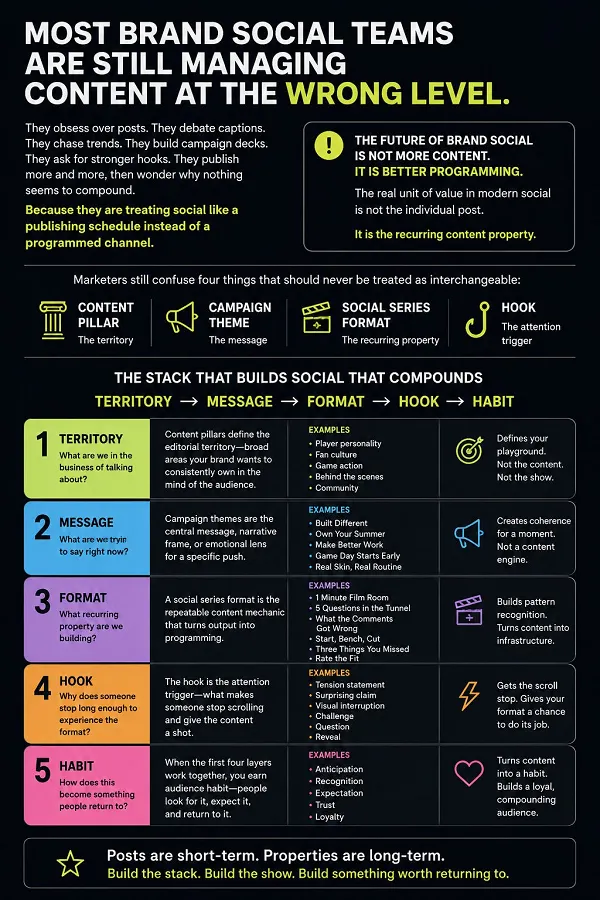
Cicero's content strategy framework is structured around four essential components, designed to guide brands in creating impactful social media presence:
Territory: This refers to the broad areas a brand aims to dominate in the audience's perception. For instance, a sports brand might claim ownership over fan culture, while a B2B company could emphasize executive insights.
Message: At the heart is the core message brands wish to convey. It's vital to grasp the value of the brand's offerings to consumers, considering why the product matters and the problems it solves in users' lives.
Format: Committing to a specific content format, such as a regular interview series or explainer videos on technical topics, strengthens brand association and promotes habitual engagement.
Hook: Every content series requires an initial hook to draw in viewers, but Cicero emphasizes the importance of following through to cultivate community and sustained audience interest.
By using this framework as a foundational guide, marketers can commit to producing content that aligns with these principles, fostering habitual engagement with their target audience.
Aligning with Modern Usage Trends
Cicero advocates for an entertainment-centric focus that integrates these branding elements to reinforce core messaging and solidify brand value. This approach resonates with current social media behaviors, where users prioritize entertainment over social connections. Recommended videos dominate feeds, making consistent, brand-aligned content essential for building reputation and relationships over time.
In 2026, as tracked by like.tg, this shift underscores the importance of moving beyond sporadic posts. Brands that create recurring, value-driven content series are better positioned to embed themselves in users' daily routines, turning passive scrolling into active engagement.
Visual Overview of the Framework
Cicero has compiled these insights into a practical infographic that outlines the key concepts in an accessible flow.
Retrieved from https://nickcicero.substack.com/p/the-future-of-brand-social-is-programming
Implications for Marketers in 2026
The transition from connective tools to entertainment platforms represents a pivotal change in social media's role. Brands that fail to adapt risk being overlooked in algorithmically curated feeds. Cicero's framework offers a roadmap for success, emphasizing consistency and relevance to user needs.
For example, a brand focusing on territory like wellness could develop a message around daily empowerment, delivered through a format of short motivational videos with a hook of real-user transformations. Over time, this builds anticipation and loyalty, as audiences associate the brand with reliable, entertaining content.
Data from like.tg indicates that such strategies lead to higher engagement rates, with recurring formats seeing up to 30% more interaction compared to one-off posts. This is particularly relevant in an era dominated by short-form videos on platforms like TikTok and Instagram Reels, where algorithms favor content that keeps users hooked.
Marketers should start by auditing their current social media efforts against these four elements. Identify gaps in territory ownership, refine core messages, standardize formats, and craft compelling hooks that promise ongoing value. Commitment to this process can transform sporadic visibility into sustained brand affinity.
Challenges and Opportunities Ahead
While implementing this strategy requires investment in content creation and analysis, the rewards are substantial. Challenges include maintaining consistency amid algorithm changes and competing with viral trends. However, opportunities arise from building authentic communities that drive long-term loyalty and advocacy.
Cicero's two decades of expertise underline that success in modern social media hinges on treating content as programming, much like television series that viewers return to week after week. Brands adopting this mindset in 2026 will likely see improved metrics, from reach to conversion rates.
In conclusion, as social media continues to evolve, strategies like Cicero's provide a vital blueprint for brands aiming to thrive. By focusing on entertainment value and consistent messaging, marketers can forge meaningful connections in an increasingly competitive digital landscape. For more details on this framework, refer to Cicero's original outline at https://nickcicero.substack.com/p/the-future-of-brand-social-is-programming.
Contact Us