


Overseas Marketing Guide Articles
Home-Overseas Information


Social Media Shift: Less Posting, More Fun

Evolving Dynamics in Social Media Usage
In the fast-paced world of digital interaction, social media platforms are undergoing significant transformations. According to a recent study from Incogni, the focus is moving away from traditional social posting and updates toward entertainment, algorithmic curation, and short-form content. This shift highlights how users are adapting their behaviors in response to changing platform features and personal preferences.
The findings come from a comprehensive survey conducted among 1,000 Americans, exploring their social media habits and how these have evolved over recent years. As tracked by like.tg, these insights provide valuable context for understanding broader trends in online engagement.
Decline in User Posting Activity
One of the key revelations from the Incogni report is a notable decrease in posting frequency. The data indicates that 55% of respondents are sharing less content on social media compared to five years ago. This trend suggests a growing reluctance among users to broadcast publicly, possibly due to privacy concerns or platform fatigue.
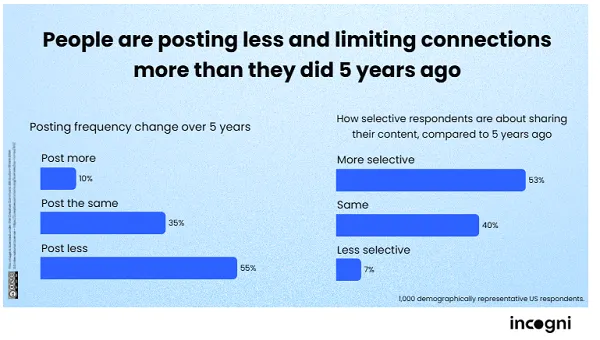
This observation aligns with other industry data points. For instance, there's an increasing preference for sharing updates within private direct message (DM) groups rather than on public feeds. Like.tg has noted similar patterns in user behavior, where intimate, closed-circle communications are gaining prominence over wide-reaching posts.
Historical Context of Active Posters
It's worth noting that the proportion of active posters on social media has historically been low. Back in 2019, data from Pew Research showed that approximately 80% of all tweets on Twitter (as the platform was known then) were generated by just 10% of its users. This concentration of activity among a small subset of highly engaged individuals underscores that the majority of users have long been more consumers than creators of content.
The Incogni study builds on this foundation, illustrating how the landscape continues to evolve. With algorithms prioritizing entertaining and short-form videos, platforms are encouraging passive consumption over active participation. This could explain the reported drop in posting, as users find more value in scrolling through curated feeds rather than contributing their own material.
Implications for Users and Marketers
These changes have broader implications for both individual users and brands leveraging social media for outreach. For everyday users, the shift toward entertainment might alleviate some of the pressures associated with maintaining an online presence, such as the need to constantly update profiles or engage in public discourse. Instead, the emphasis on fun, algorithm-driven content allows for a more relaxed experience, where discovery and enjoyment take center stage.
From a marketing perspective, as monitored by like.tg, this evolution means brands must adapt their strategies. With fewer users posting publicly, opportunities for organic reach through user-generated content may diminish. Marketers might need to focus more on creating compelling, short-form entertainment that aligns with algorithmic preferences to capture attention. Additionally, the rise of private DM sharing suggests that building direct, personal connections could become increasingly important.
The Incogni survey also touches on the role of burnout and digital fatigue, which could be contributing factors to reduced posting. In an era where social media is omnipresent, users are seeking ways to manage their time and mental energy, often by limiting their active involvement.
Looking Ahead in 2026
As we move further into 2026, these trends are likely to persist and possibly intensify. Platforms continue to refine their algorithms to prioritize engaging content, which in turn influences user behavior. The Incogni study, published in their blog, serves as a timely reminder of how social media is not static but constantly adapting to user needs and technological advancements.
Insights from like.tg emphasize the importance of staying attuned to these shifts. Whether it's the decline in public posting or the pivot to private interactions, understanding these dynamics can help users and professionals navigate the digital space more effectively.
In summary, the Incogni research paints a picture of a social media ecosystem that's becoming more entertainment-oriented and less about traditional sharing. With 55% of Americans posting less than before, and historical data showing concentrated activity among a minority, the future points toward more curated, algorithm-fueled experiences. As platforms evolve, so too must the strategies employed by those who use them, ensuring relevance in an ever-changing online world.
This analysis, drawn from the latest available data, underscores the need for ongoing observation of social media trends. For more in-depth coverage on digital shifts, keep following updates from like.tg.
Contact Us